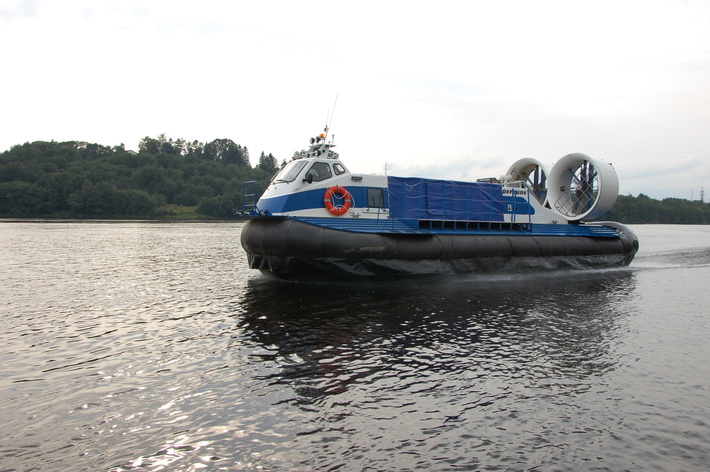
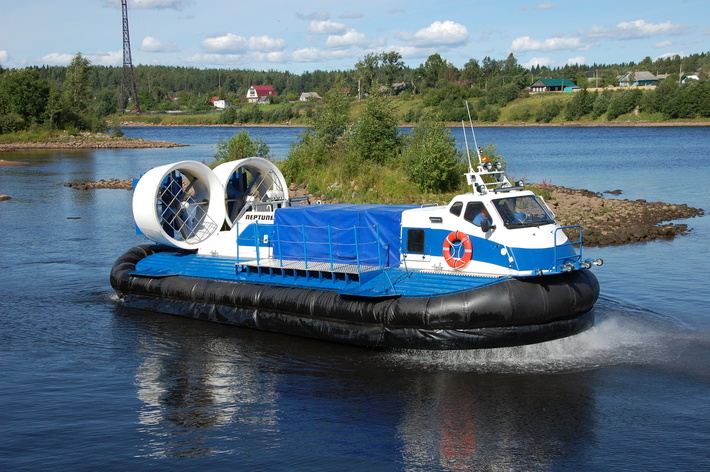
 Purpose. The cargo-passenger amphibious hovercraft type «Neptune 23GrPasML» is designed to transport cargo in an amount of no more than 1700 kg or passengers in the amount of 6 people and cargo not more than 1250 kg.
Vessel category. The vessel belongs to closed small vessels of category *3.
Acceptable areas of operation. The vessel can be operated in coastal sea areas and inland water basins. Limitations during operation — wave height of 1% probability up to 1.2 m, distance from the place of refuge no more than 11 km (6 miles).A place of refuge is any piece of land, a bay, a ship on a roadstead, where a ship can hide from bad weather.Operating period. The vessel can be operated all year round. Type of surface: — along the water surface without depth restrictions; — in shallow water, including zero depth and shallows; — along the frozen and snow-covered surface of reservoirs, in the absence of hummocks along the route that are higher than the height of the air cushion; — on ice slush and floating ice; — on a waterlogged swampy surface and in sparse thickets of reeds with a height that does not impede visibility for driving. The exit and movement of the vessel is allowed on unobstructed areas of the flat shore. When driving on ice or snow-covered surfaces of water bodies, there is no restriction from the place of refuge.Temperature conditions. Operation is permitted at outdoor temperatures from minus 40ºC to plus 40ºC.
Wind restrictions. Wind speed is limited to 12 m/s.
Restrictions on time of day. The vessel can be operated both in daylight and in the dark. When operating in the dark, additional lighting is installed (high beam spotlights).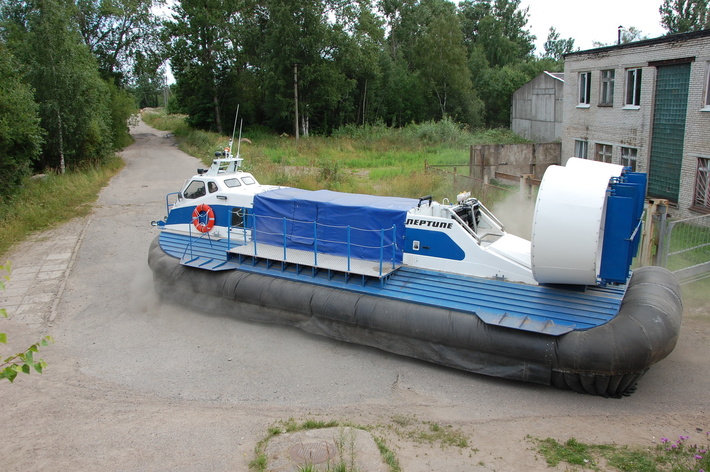 Architectural and structural type. An amphibious-type hovercraft with a two-tier flexible fence along the entire perimeter, a separate lifting and propulsion complex with two twin centrifugal superchargers and two variable-pitch propellers in aerodynamic nozzles, with an aft location of the engine compartment, with simplified hull shapes, with five watertight bulkheads.
Norms and Rules. Hovercraft is designed to comply with the requirements of the “Guidelines for the classification and inspection of small vessels” R.044-2016 of the Russian River Register and the “Technical Regulations on the Safety of Inland Water Transport Facilities” Resolution of the Government of the Russian Federation dated 08/12/2010 N 623 (as amended on 04/30/2015).
Main dimensions:
| No. | Characteristic name | Unit change | Numerical value |
| 1 | Dimensions with hinged rigid structures:
Length Width with side hinged sections Height on hard surface with mast |
Mmm |
11,88 4,68 3,51 |
| 2 | Dimensions according to the waterproof case:
Case length Case width Side height |
Mmm |
11,7 1,9 0,75 |
Composition of the payload when transporting cargo and passengers:
| Name | Weight, kg |
| Fuel | 340 |
| Crew (1-2 people) | 150 |
| Cargo | 1250 |
| Passengers (6 people) | 450 |
| TOTAL | 2190 |
 Fuel consumption. Fuel consumption when driving through calm water with an operating load at a speed of 40-45 km/h is about 30 l/h. Specific consumption under these conditions is 0.6-0.8 l/km.
Load location. The cargo is placed on the deck. The deck is located between the salon and the fuel tank compartment. The deck has dimensions; length 4.0m, width 2.0m. It is possible to cover the deck with an awning. The deck has brackets for securing cargo. The deck has an anti-slip surface. It is possible to increase the width of the cargo area by hanging sections. The total deck area will be 4x4sq.m. In the area of the deck, a removable railing is installed on the hinged sections.
Travel speed. A Hovercraft with an average operational load has in windless, calm weather: maximum speed on water — 65 km/h maximum speed on an ice surface 75 km/h Operating speed. Operating speed on water is 40-45 km/h, on dense snow-covered surface 50-60 km/h.
Amphibious qualities. The amphibious qualities of the hovercraft are ensured by the separation of the body from the screen due to the holding of an air cushion under the body by a flexible enclosure. The lifting height depends on the speed of the superchargers (engines), the load and the running trim angle. The maximum achievable height of the air cushion is about 0.75 m. The height of the air cushion is measured from the supporting hard surface to the bottom of the housing.
Flexible fencing. To form an air cushion on the vessel, a flexible fence is provided around the entire perimeter. The flexible two-tier fencing consists of an upper tier — a receiver and a lower tier — removable elements. The flexible fencing has an internal contour consisting of longitudinal and transverse inflatable keels. The flexible fencing material is rubberized fabric based on nylon textiles.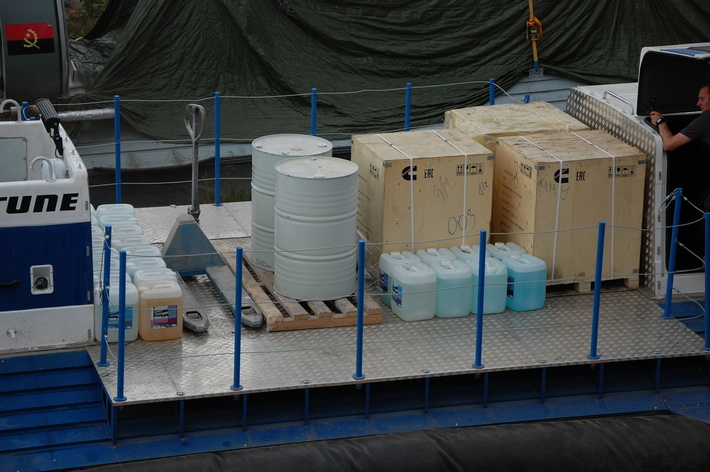 Frame. General information. Sheets and profiles made of aluminum alloys are used as the material for the main body, set, and foundations. Rolled sheets are used grade Amg5M, GOST 21631-76. Profile steel grade Amg6M or D16T according to GOST 8617-75.
Chopping. General information. The cabin is made of fiberglass and has an aerodynamically streamlined shape. The cabin is made of a three-layer structure, the middle layer of which is insulation. The outer layer is made of fiberglass based on polyester resin with fiberglass reinforcing material. The middle layer is made of tile foam. The inner layer is made of fiberglass, covered with lining — pile fabric.
Main engines. It is planned to install two automobile diesel engines produced by Cummins, brand ISF2.8, as the main engines — four-cylinder with in-line vertical arrangement of cylinders, turbocharged, with intermediate cooling of charge air, with distributed fuel injection «Common Rail». The maximum permissible speed is 3200 rpm. The main characteristics of each engine: maximum power, kW (hp) — 110 (149.6); number of cylinders, pcs. — 4; cylinder volume, l — 2.8.
Fuel system. The fuel system consists of two fuel tanks, each with a capacity of 200 liters. Transmission. The hovercraft is equipped with two power units that distribute engine power to the supercharger and the propeller. The power unit includes flat-toothed drive belts, pulleys with shafts mounted in bearings. The hovercraft has two independent transmissions on the left and right sides, each of which transmits torque on its side from the power unit to the propeller and supercharger. The transmissions include cardan drives.
Propulsors. The hovercraft uses two variable pitch propellers in aerodynamic fixed nozzles as propellers. The variable pitch propeller support unit and the reverse mechanism are located in the pylons of each nozzle. The material of the propeller blades is fiberglass coated with aramid fabric (Kevlar). The angle of rotation of the propeller blades is changed by electric pedals and controlled by direction indicators installed in the control panel.
Airbag blowers. Two twin centrifugal superchargers are provided as air cushion superchargers. Air cushion blowers operate separately, each on its own side. The superchargers are mounted on shafts supported on both sides by self-aligning bearings. The supercharger material is fiberglass with the addition of carbon and aramid fabrics (carbon and Kevlar).
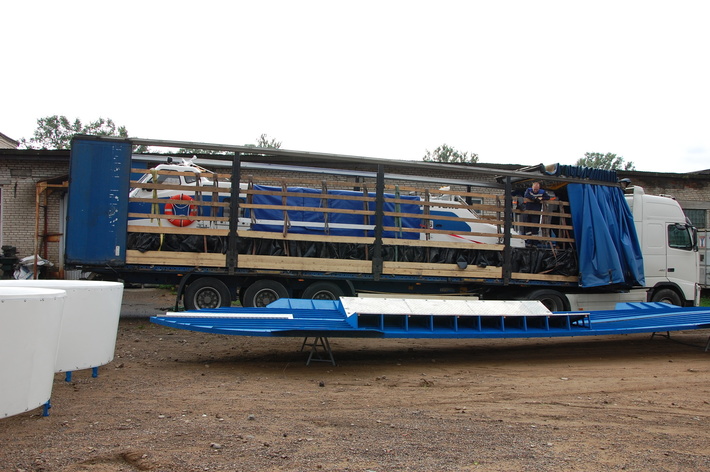
Transportation. Transportation by road is provided without restrictions within a size of 2.5 m. The vessel will be shipped in a 40HC container. At the same time, the side mounted sections, attachments with rudders hung on them, and propeller pylons are dismantled. Dismantled products are sent separately in a 40-foot container or by road.